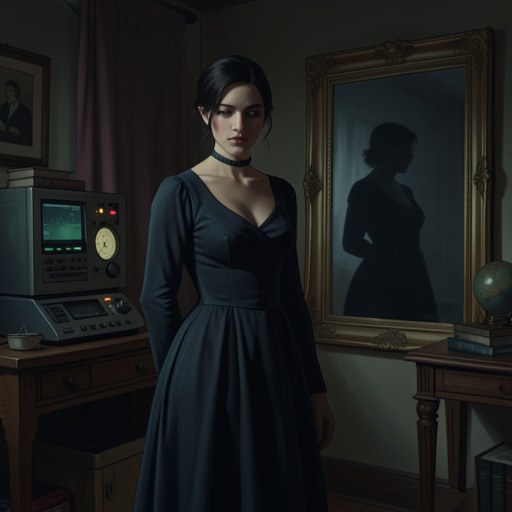
Austin entrusts Maud with the cabinet key
Uncle SilasAustin entrusts Maud with the cabinet key in a hushed, carefully circumscribed scene that gives a child responsibility for an unexplained object and makes obedience part of a larger family secret. The instruction is more than a practical reminder: it establishes a narrow channel of trust between Austin, Maud, and Doctor Bryerly, while foreshadowing the will that will place Maud’s future in Silas Ruthyn’s hands.
The key and the scene
While Maud sits thinking, Austin appears close beside her, his imposing figure startling her. He watches her briefly, takes a heavy candlestick, and silently beckons her to follow. They cross the lit hall and enter his dim library, where one candle burns and a carved oak cabinet stands beside the door. The sequence moves from an unexpected summons to a secluded room and a specific object, making the setting part of the instruction’s secrecy.
Austin studies Maud and the key before abruptly telling her to remember it. She describes it as oddly shaped and unlike other keys. He taps it against the cabinet and identifies what it opens, then gives her a simple but exact rule: during the day it is kept in its usual place; at night he puts it beneath his pillow. He makes her repeat the cabinet’s location and description—the oak cabinet next to the door on her left—so the instruction can be carried out accurately rather than remembered as a vague warning.
Secrecy and the permitted exception
Austin first forbids Maud to tell anyone what he has said, under pain of his displeasure. The prohibition makes the key a confidence as well as an object, and Maud’s immediate assent reflects her fear of disobeying even a small instruction from her father. He kisses her forehead, briefly joining the scene’s stern secrecy to an expression of affection.
The rule has one carefully defined exception. If Austin is absent and Doctor Bryerly comes to ask for the key, Maud is to give him the relevant information; nobody else is included. Austin identifies Bryerly for her as the thin gentleman in spectacles and a black wig who had recently spent three days at the house. Later, Austin specifies that Bryerly should be told both about the key and what it opens. The exception makes Bryerly the only authorized recipient, while leaving Maud responsible for recognizing the circumstances in which the secrecy must be broken.
From private instruction to the will
The cabinet-key scene acquires a larger meaning when Austin’s will is read. His estate is placed in trust for Maud, with four trustees named, including Doctor Bryerly; Silas receives a bequest of £15,000 and the use of Bartram-Haugh and adjoining lands for life at an annual rent of five shillings. Maud’s father also appoints Silas her sole guardian until she turns twenty-one, requires her to live under his care at Bartram-Haugh, and directs the trustees to pay him £2,000 annually for her maintenance, education, and expenses.
The will thus establishes a consequential contrast with the earlier instruction. In the library, Austin entrusts Maud with a key but narrowly specifies when she may disclose its purpose and to whom. In the will, he entrusts Silas with Maud herself, granting him parental authority while making her inheritance conditional on her survival to adulthood. Doctor Bryerly later points out that, if Maud dies before twenty-one, the entire property will pass to Silas. The earlier appointment of Bryerly as the sole permitted recipient of the cabinet information therefore sits alongside his later role as a trustee who understands the risks built into the guardianship.
The ordeal and its reversal
Austin’s own explanation of the will, found later in copies of letters to the trustees, recasts the guardianship as an attempted vindication of his brother. He calls Silas oppressed and unhappy, describes the accusation against him as a slander, and says that making him guardian—and leaving him the estate if Maud dies under age—is an ordeal intended to demonstrate confidence in him. Austin believes Maud will be as safe in Silas’s care as in his own. The protection he intends to confer on Silas’s reputation therefore depends on placing his daughter under Silas’s control.
That confidence is tested when Doctor Bryerly challenges Silas over the estate. He argues that Silas is exercising a power he does not lawfully possess and that the resulting impoverishment of the estate benefits Silas at Maud’s expense. Against that later dispute, the key instruction reads as an early instance of Austin’s method: authority is assigned through precise rules and private assurances, but the person charged with obeying them has only limited control over what the arrangement ultimately means. The key itself remains a focused secret; the will reveals the wider and more perilous trust into which Maud has been placed.